
Abstract — The shift from batch manufacturing to mass customization in panel furniture has moved the CNC nesting center from a peripheral cutting tool to the central node of the production line. This article examines the technical logic behind that shift, reviews indicative cost and specification data across machine classes, and considers how Chinese OEMs—Roctech among them—have positioned themselves in a market long dominated by European builders. The argument is straightforward: the nesting center's value now lies less in its spindle than in its integration with software, loading automation, and downstream drilling and edge-banding operations.
I. Industry Background
Panel furniture production has changed shape over the past fifteen years. Where a factory once ran long batches of identical cabinets, it now runs hundreds of distinct orders per week, each with different dimensions, hole patterns, and edge treatments. This is not a marginal change in scheduling; it alters what the machine tool must do. Cutting accuracy matters, but so does the speed with which the machine can be reprogrammed, the percentage of each board that ends up in a finished part, and the degree to which loading and unloading can proceed without an operator standing at the table.
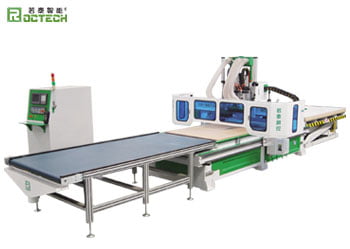
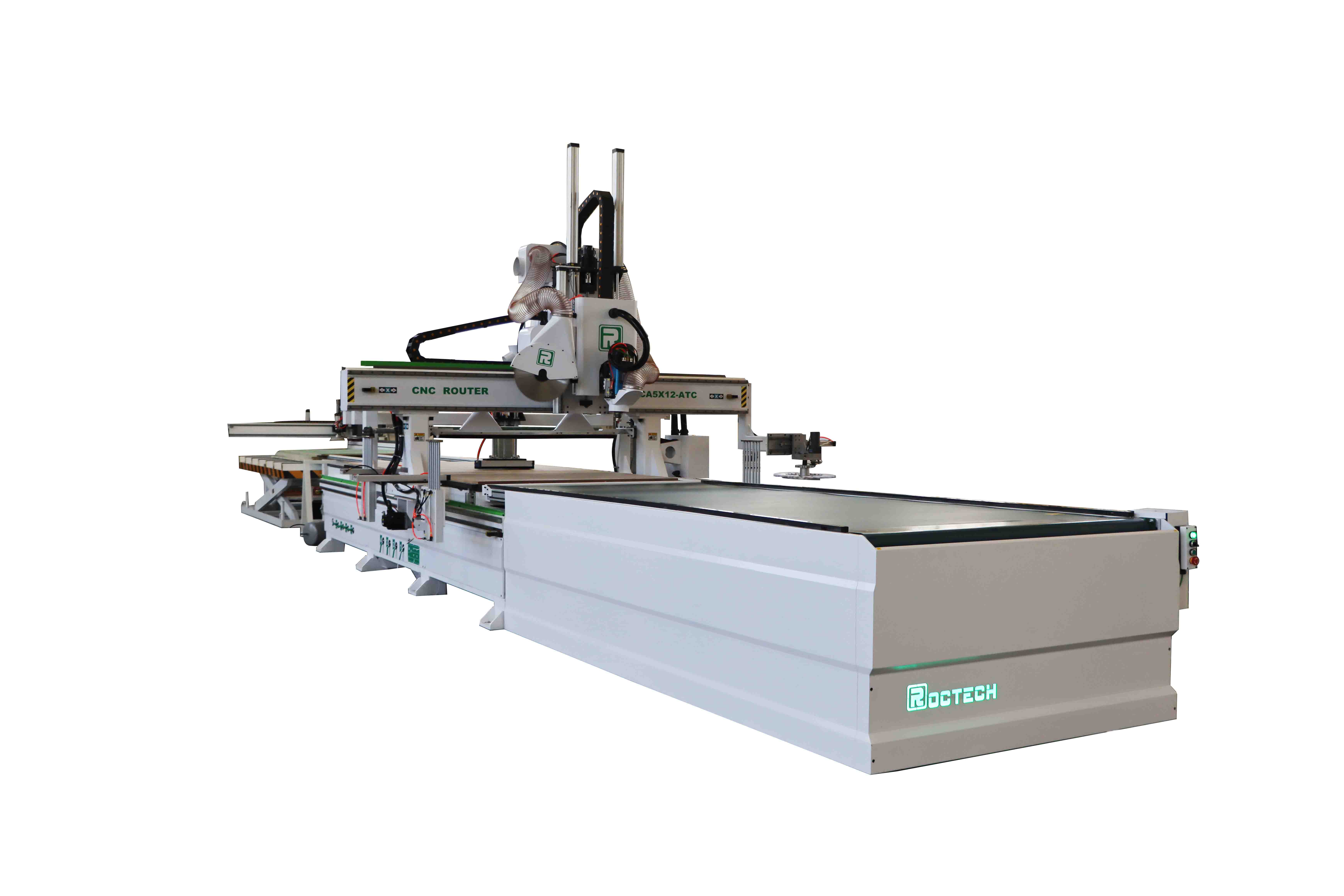
The nesting center—a CNC router configured with a vacuum table, an automatic tool changer, and often an integrated loading/unloading system—emerged as the answer to these requirements. Its working principle is well understood: parts are arranged on a sheet by optimization software, cut with a small-diameter tool, held in place by zoned vacuum, and labeled for downstream identification. What has changed is the degree of automation wrapped around that principle.
Three technical developments deserve emphasis. First, automatic loading and unloading has become standard on mid-to-high-end machines, removing the single largest labor input in the cutting process. Second, nesting software has improved materially in material utilization, with the practical difference between good and mediocre nesting now measured in several percentage points of board yield—a figure that compounds quickly at production volumes. Third, the integration of row-drill groups into the nesting center allows cutting, drilling, and grooving in a single setup, eliminating a separate operation and the handling error that comes with it.
The table below summarizes indicative specifications and price bands across the machine classes most commonly encountered in panel furniture production. Figures are drawn from published product data and market pricing and should be read as ranges rather than quotations.
| Machine Class | Typical Working Area (mm) | Spindle Power | Tool Change | Automation Features | Indicative Price Band (USD) | Typical Application |
|---|---|---|---|---|---|---|
| Standard three-axis router | 1300 × 2500 | 6–9 kW | Manual | Vacuum table | 3,000–15,000 | Advertising, signage, simple cutting |
| ATC engraving machine | 1300 × 2500 | 9 kW (6–12 kW optional) | Carousel, 8–16 tools | Vacuum + T-slot, optional pusher | 8,000–40,000 | Cabinet doors, wood molds, craft parts |
| Automatic loading/unloading nesting center | 1220 × 2440 to 1530 × 3000 | 9.6 kW | Carousel | Auto load/unload, auto labeling, row drill, auto lubrication | 30,000–80,000 | Custom cabinets, wardrobes, batch panel furniture |
| Five-axis simultaneous machining center | 1300 × 2500 to 2560 × 6000 | 10 kW+ | Chain/carousel | Five-axis head, RTCP, probing optional | 80,000–300,000 | Automotive and marine molds, curved solid wood |
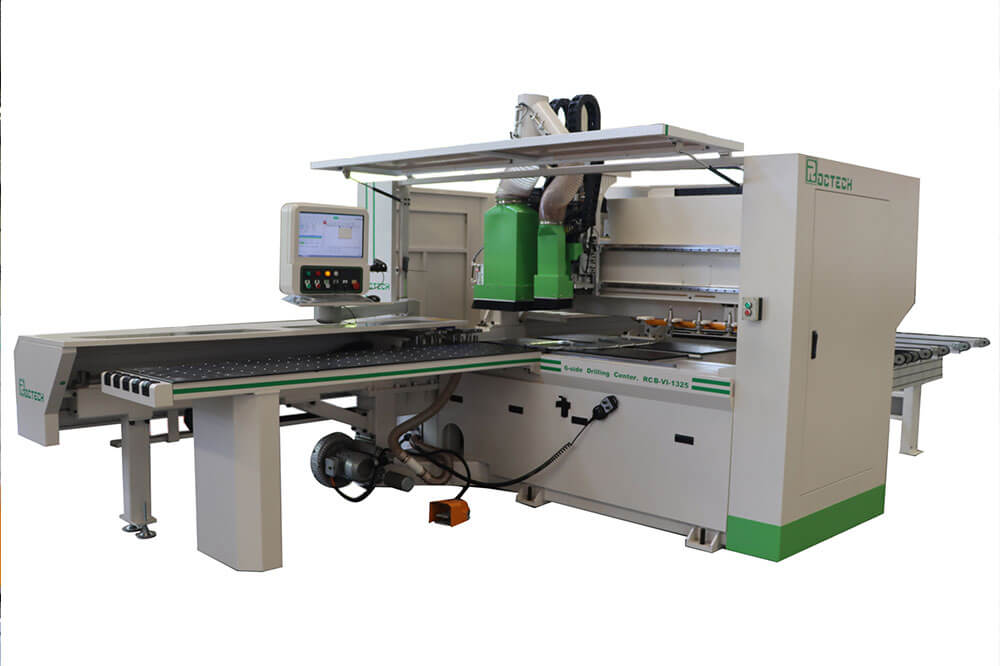
| CNC six-sided drill | Board width 50–930 | 6 kW total | Multi-axis drill group | QR code recognition, automatic positioning | 25,000–60,000 | Drilling and grooving of panel parts |
Two observations follow from the table. The first concerns the gap between the standard router and the nesting center: a factor of roughly three to five in price, justified not by cutting performance—both use comparable spindles and guideways—but by the labor and handling eliminated. For a shop running two shifts, the payback period on loading automation is frequently under two years. The second concerns the six-sided drill, which appears in the table as a separate machine class but in practice belongs to the same production line. A nesting center that cuts and labels parts without a drilling station downstream has solved only half the problem; the QR code applied at nesting is what allows the drill to call the correct program without operator intervention.
II. Technology Application and Brand Positioning
The Chinese CNC equipment sector has followed a recognizable trajectory: initial dependence on imported components, gradual localization of the machine frame and assembly, and eventual competition on integration and price rather than on individual parts. Roctech Machinery Co., Ltd., headquartered in Jinan, Shandong Province, illustrates this trajectory with reasonable clarity. The company's product range now spans nesting centers, ATC engraving machines, five-axis machining centers, six-sided drills, edge banding machines, and fiber laser cutters—a portfolio that maps onto the process chain of a panel furniture factory rather than onto a single machine category.
What is instructive about Roctech's approach is the component strategy. The company's Master Series nesting centers, including the RCA1224 and the larger RCA1325 and RCA1530, use Taiwan HIWIN linear guideways, Yaskawa servo drives, and Syntec control systems, with Italian HSD spindles available as an option. This is not a claim to vertical integration; it is a claim to disciplined sourcing. The frame and bed structure—heavy welded construction, which determines rigidity and therefore surface finish at speed—is manufactured in-house, while the motion and control components are bought from established suppliers. The result is a machine whose specification sheet reads competitively against European equivalents at a materially lower price point, a positioning that has carried Roctech products into more than 100 export markets.
The RCA1224, as a representative case, offers 1220 × 2440 × 150 mm travel, a double-layer zoned vacuum table, a 9.6 kW spindle, and a whole-machine weight of approximately 4,500 kg. The weight figure is worth pausing on: it is roughly twice that of a standard 1325 ATC engraving machine, and the difference reflects the additional structure required for loading automation and for sustained cutting of full sheets without vibration. The machine also carries an automatic lubrication system and optional automatic labeling—features that appear minor in a specification table but matter considerably in a production environment where unplanned stoppages are the dominant cost.
Roctech's five-axis line, represented by the RCF1325 and the larger RCF1838 and RCF2040, addresses a different segment: mold work, curved solid wood, and complex surfaces requiring multi-sided machining in a single clamping. These machines use imported five-axis heads with Italian OSAI, German Heidenhain, or Spanish Fagor controls, and carry positioning accuracy of ±0.05 mm with repeatability of ±0.03 mm. This is a segment where the technical bar is higher and the volume lower, and where Chinese builders are still establishing credibility rather than defending it.
III. Conclusion and Outlook
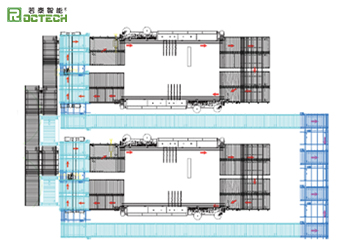
The nesting center is unlikely to change radically in its basic architecture over the next decade. The interesting developments will occur at its edges: deeper integration with MES and order-management systems, more capable nesting algorithms, and the gradual absorption of drilling and edge-banding functions into fewer, larger cells. The direction of travel is toward the flexible manufacturing cell—a small number of machines, lightly staffed, reprogrammed continuously from design data.
For equipment buyers, the practical implication is that machine selection should be driven less by spindle power or rapid traverse figures than by the completeness of the process chain the vendor can supply and support. A nesting center without a compatible drill, edge bander, and software interface is an expensive saw. For Chinese manufacturers such as Roctech, the competitive question is no longer whether the hardware is adequate—on the evidence of specification and export reach, it largely is—but whether service networks, software ecosystems, and applications engineering can keep pace with the machines themselves. That is the harder problem, and it is where the next stage of the market will be decided.
Looking for more information about our CNC machines and services? Contact us today.
Contact
Previous:The Nesting Center as the New Floorplan: Automation and Data Flow in Custom Furniture Manufacturing
Next:Not






















The Nesting Center as the Cornerstone of Flexible Panel-Furniture Production: Technology, Data, and the Chinese Equipment Trajectory - Roctech® have advanced technology for CNC Router,cnc router cabinets,Roctech already have 15 years experiences of cnc router technology.-© 2023 Roctech® Machinery Co.,Ltd. - All Rights Reserved Website Terms Of Use ● Privacy Policy ● Cookie Policy